Naxos villages car rental tour
Inland Naxos

Beyond the Beach: Villages & Culture

Marble lanes at 600 metres, a temple doorway older than the Parthenon, Venetian towers standing in olive groves, and the highest mountain in the Cyclades. The other half of the island starts where the sand ends.

40+ villages 2,600 years of ruins Local guide, 2026
Traditional Villages

Five villages, five different islands

Naxos has more than forty settlements, and the ones inland have almost nothing in common with the whitewashed cliché of the Cyclades. Start with these.

Naxos Chora waterfront harbour view

Chora (Naxos Town)

The port, the capital and the base for most visitors. Behind the waterfront, a vertical maze of vaulted lanes climbs to the Venetian Kastro, where the descendants of the Sanudo dukes still occupy houses with coats of arms above the door.

Sea level · 0 kmEvenings
Best way to get thereChora is where you are based — explore it on foot. Leave the vehicle in the free port car parks; the Kastro lanes are pedestrian and unreachable by car anyway. Compare vehicles for the rest of the island →
Apeiranthos village Naxos marble lane

Apeiranthos

The island's most striking village, built and paved entirely in marble at 600 metres. Settled from Crete centuries ago, it keeps its own dialect, four small museums and a stubbornly unhurried pace.

600 m · 26 kmHalf day
Best way to get thereThe climb to Apeiranthos at 600 m favours a car for comfort, or a capable scooter for confident riders. Park at the village edge and walk the marble lanes. Compare vehicles →
Halki village Naxos historic centre

Halki

The commercial capital of Naxos until the twentieth century, and it shows: neoclassical mansions, a traditional kitron distillery working since 1896, and the Panagia Protothroni church with frescoes layered across a thousand years.

350 m · 17 kmHalf day
Best way to get thereHalki sits on easy paved valley roads — comfortable by scooter or car. A car helps if you plan to carry home oil, cheese or kitron from the village shops. Compare vehicles →
Filoti village Naxos mountain slopes

Filoti

The largest inland village, spread across the lower slopes of Mount Zas. Less picture-perfect than Apeiranthos and far more lived-in — this is where you eat lunch under plane trees and start the walk up the mountain.

350 m · 20 kmBase for Zas
Best way to get thereAny vehicle reaches Filoti on good roads; a car is best if you continue to the Zas trailhead and want to leave bags and water safely while you hike. Compare vehicles →
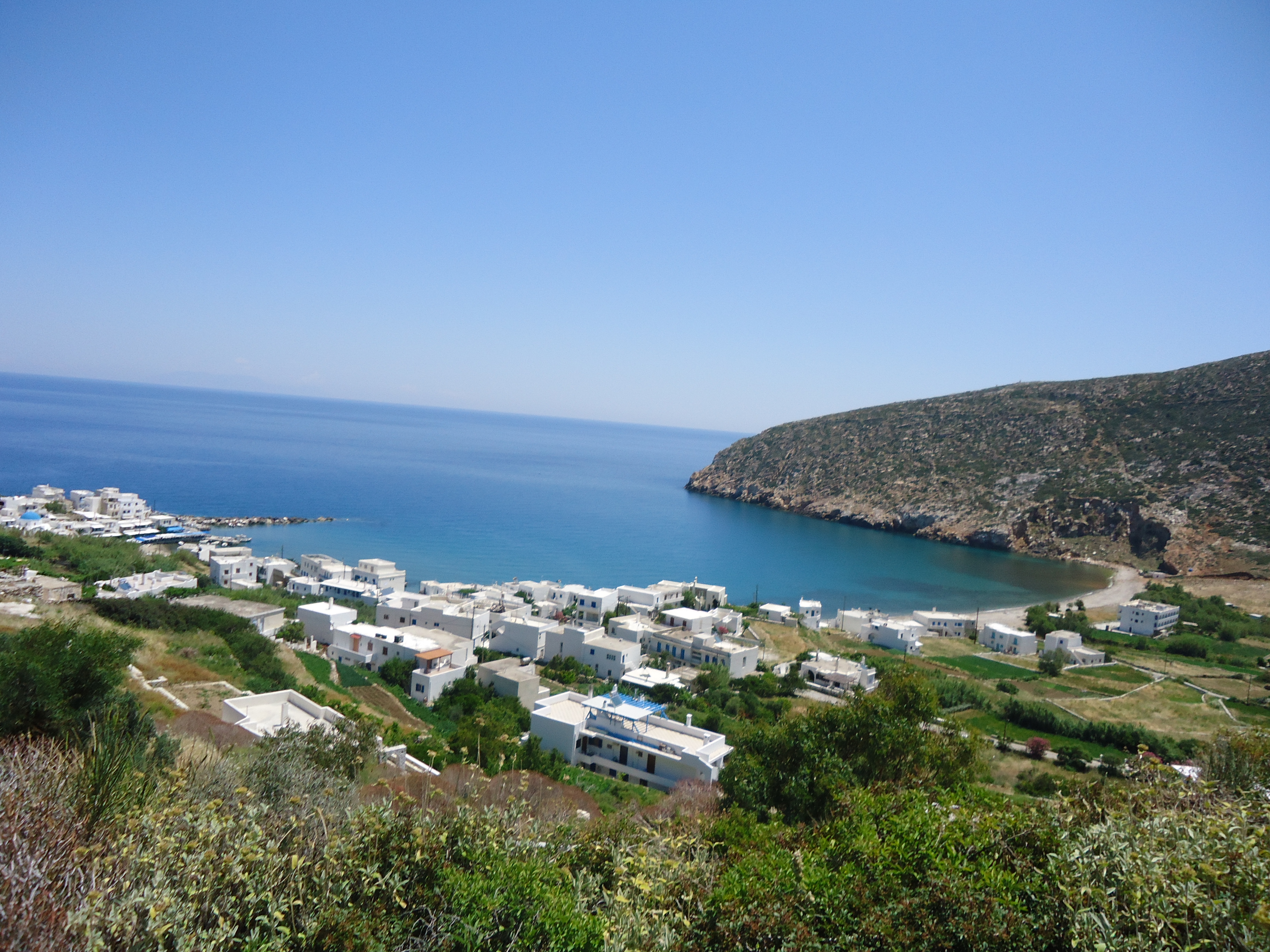
Apollonas village Naxos fishing harbour

Apollonas

A fishing harbour at the far north of the island, an hour and a quarter from Chora. The reward for the drive is fish straight off the boat and, in the hillside quarry above, a colossal unfinished kouros abandoned mid-carving.

Sea level · 48 kmFull day
Best way to get thereApollonas is an hour and a quarter north over the mountains — a car is the sensible choice for the distance and the fuel-scarce route. Make it a full-day loop. Compare vehicles →
Koronos village Naxos hillside houses

Koronos

Built into a ravine like an amphitheatre, with houses stacked in tiers and a stream of steps instead of streets. The old emery-mining heart of Naxos, and the least touristed village on this list.

540 m · 37 km2 hours
Best way to get thereKoronos is deep in the emery mountains on winding roads — take a car, or a bigger scooter if you are an assured rider. Narrow lanes mean you park and walk down the steps. Compare vehicles →

All six villages fit into two driving days

Buses reach two of them, a few times a day. A rental vehicle links all six — and gets you home after dinner.

Rent a car to explore these villages
Portara Naxos Apollo temple ruins
Ancient Naxos

The Portara & the marble giants

The Portara is a single marble doorway, six metres high and weighing around twenty tonnes, standing alone on the islet of Palatia at the mouth of Naxos harbour. It was the entrance to a temple of Apollo begun by the tyrant Lygdamis around 530 BC and abandoned when he fell from power. Everything else was carted off over the centuries to build the Kastro. The door survived because it was too heavy to move.

I

Temple of Demeter

Near Ano Sangri, a small Ionic temple of about 530 BC, built entirely of Naxian marble and partly reconstructed from its own fallen blocks. It stands alone in open farmland with a tiny site museum — one of the most atmospheric ancient sites in the Cyclades precisely because nobody is there.

II

The kouroi of Melanes

Two unfinished marble youths from the 6th century BC lie on their backs in an orchard at Flerio, cracked in the carving and left where they failed. You can walk right up to them. A ten-minute detour off the Chora–Melanes road.

III

The kouros of Apollonas

The biggest of them all: 10.7 metres of bearded figure, still attached to the bedrock of the quarry above the northern village. Probably intended as Dionysus, probably abandoned when the marble split. Free to visit, and impossible to photograph well.

Kastro quarter Naxos Chora alley
Venetian Naxos

Towers, the Kastro and 350 years of Latin rule

In 1207 the Venetian Marco Sanudo took Naxos and made it the capital of the Duchy of the Archipelago, which ran the Cyclades for three and a half centuries. That history is still standing.

In Chora, the Kastro is a complete fortified quarter: a ring of connected house-walls forming the defences, a Catholic cathedral, the surviving Glezos tower and narrow vaulted lanes that stay cool at midday. It is the only inhabited medieval castle town in the Cyclades, and several families in it descend directly from the original Venetian nobility.

Across the countryside stand the pyrgoi — fortified tower houses built by Venetian and later Greek landowners to defend estates against pirates. The restored Venetian tower on the Sangri road, now used as a summer cultural venue, is the easiest to visit. Others sit in fields near Halki, Melanes, Sangri and Agia — many are private, but they are visible from the road and unmistakable once you know the shape.

Most of these towers are on the same inland routes as the villages above. Our driving routes guide links them into a single afternoon.

Naxos mountain village hiking trail Zas: 1,004 m, the roof of the Cyclades
On Foot

Hiking trails across the interior

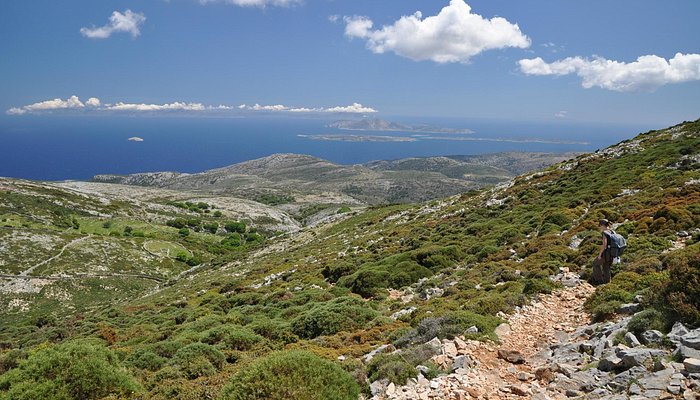
Naxos has the only serious walking network in the Cyclades — a mix of ancient stone paths, shepherd tracks and marked routes, most of them still used by the people who live here. Spring and autumn are the seasons; summer walking means starting at dawn.

  • Mount Zas — 3–4 hours return, hard. From the Agia Marina chapel above Filoti to the 1,004-metre summit. Rocky underfoot, no shade, exceptional views across to Paros, Ios and Amorgos. Take two litres of water per person.
  • The Zas cave — 1.5 hours return, moderate. A shorter alternative approach to the same mountain, ending at the cave where, in myth, Zeus was raised. Can be combined with the summit as a loop.
  • Tragaea valley circuit — 2–3 hours, easy. Between Halki, Moni and Kaloxylos on shaded flagstone paths through olive groves, past a dozen Byzantine chapels including Panagia Drosiani, among the oldest in Greece.
  • Apeiranthos to Moutsouna — 4 hours, moderate, downhill. The old emery road down to the east coast, following the line of the abandoned cable-way. Arrange a pick-up at the bottom, or drive down and walk a section.
  • Melanes aqueduct trail — 2 hours, easy. Follows the route of the ancient aqueduct that fed Chora, linking the kouroi at Flerio with village springs and shaded orchards.
Local Products

What Naxos actually makes

This is a farming island first and a holiday island second. Almost everything worth bringing home is edible.

Naxos graviera cheese local produce
Graviera — the island's protected cheese
Halki Naxos Kitron liqueur shop
Kitron, distilled in Halki since 1896
Naxos village olives market stall
Olives and oil from the Tragaea
Cheese

Graviera Naxou holds PDO status and is made by the island's dairy producers from cow and sheep milk. Buy it from the dairy shops in Chora or, better, direct from a village producer inland. Aged versions travel well.

Potatoes

Naxian potatoes are grown in the sandy plain behind the west coast and are a point of genuine local pride. Sold roadside in sacks in early summer; order them fried anywhere on the island and taste the difference.

Kitron

Kitron of Naxos is distilled from the leaves of the citron tree and made nowhere else on earth. Three strengths: green (sweetest), yellow (strongest), clear (in between). The traditional distilleries in Halki give free tastings.

Naxos village panigyri festival feast Panigyria run until sunrise
Traditions

Festivals worth planning around

A panigyri is a village saint's-day festival, and on Naxos they are not folklore performances for visitors — they are the actual social calendar. Long tables in the square, food cooked in enormous pots, violin and lute, and dancing that genuinely does go until dawn. Everyone is welcome; nobody is charging admission.

The dates to know: 15 August (Dormition of the Virgin) is the biggest, celebrated across the island and especially in Filoti and Sangri. 14 July brings the Agios Nikodimos festival in Chora, the island's patron saint. 29–30 August is the Agios Ioannis panigyri at Apeiranthos.

Easter is the deepest tradition of the year: candlelit processions through the Kastro on Good Friday, midnight fireworks on Saturday, and whole villages eating together on Sunday. Rooms and vehicles book out well ahead.

Almost every panigyri happens in an inland village, at night, with no bus. Plan transport before you plan the evening — and if you are driving, someone in the group stays sober.

With Children

Family days that are not a beach day

  • The kouroi at Flerio Giant stone figures lying in an orchard that children can walk right up to. Short, shaded, free, and far more interesting to a nine-year-old than a museum case.
  • Boat trip to the Small Cyclades Day boats leave Chora for Koufonisia, Iraklia and Schinoussa. Calm crossings, tiny harbours and swimming stops.
  • The Kastro on foot A genuine castle to get lost in, with an archaeological museum in the old Jesuit school at the top of it.
  • Horse riding on Plaka Stables near the west coast run beach and sunset rides suitable for beginners and children.
  • Windsurf lessons at the Laguna Waist-deep water for a hundred metres makes Mikri Vigla's southern lagoon an unusually forgiving place to learn. See our beach guide for the details.
  • A traditional kitron distillery in Halki Copper stills, old bottling machinery, a five-minute tour and a tasting for the adults. Free, and quicker than it sounds.
  • Mount Zas, the easy way Drive to the Agia Marina chapel and walk twenty minutes for the view without committing to the summit.
  • Goats on the inland roads Anywhere above Filoti, really. Pull over somewhere safe, wind the window down and wait — for most small passengers this ends up being the highlight of the whole drive.

Nearly everything on this page is inland

Villages, ruins, trailheads and festivals are spread across 430 km² with little or no bus service. Compare local rental companies and see them properly.

Rent a car to explore these villages
Questions

Things to do in Naxos FAQ

What is Naxos famous for?

Three things above all: the Portara, the enormous marble doorway of an unfinished temple of Apollo that frames the sunset above the harbour; its beaches, generally considered the best sand in the Cyclades; and its produce — Naxian graviera cheese, potatoes and the kitron citrus liqueur made only here. It is also the largest and greenest island in the Cyclades, with a mountainous interior of marble villages that most neighbouring islands simply do not have.

Is Apeiranthos worth visiting?

Yes — it is the single most distinctive village on Naxos. Sitting at around 600 metres on the flank of Mount Fanari, its lanes, steps and squares are paved in local marble, and its residents descend from Cretan settlers, with a dialect still noticeably their own. There are four small museums, several tavernas on the main street and a walking pace that makes the drive up worthwhile. Allow two to three hours, and go late in the afternoon when the marble turns gold.

What is the best hiking trail in Naxos?

The Mount Zas ascent from the Agia Marina chapel above Filoti. It is roughly 3 to 4 hours return, climbs to 1,004 metres — the highest point in the Cyclades — and gives you views over half the archipelago on a clear day. The Zas cave sits on the alternative approach and can be combined into a loop. For something gentler, the marked footpaths through the Tragaea valley between Halki, Moni and Kaloxylos are shaded, nearly flat and full of Byzantine chapels.

How do I get to the mountain villages of Naxos?

By road, from Chora. Buses run to Filoti and Apeiranthos a few times a day in summer, which is enough for a one-way visit but restrictive if you want to see several villages or stay for dinner — the last service back is early. Koronos, Moni, Melanes and the smaller Tragaea settlements have little or no service. Most visitors rent a car, scooter or quad and drive the inland loop, which lets you link three or four villages in a single day.

Can you visit the Portara for free?

Yes. The Portara stands on the islet of Palatia, joined to Chora by a short causeway, and the site is open and free at all hours. It is a five-minute walk from the ferry port. Sunset is the busiest and the best time to go; arrive twenty minutes early if you want the doorway to yourself for a photograph.

Your Vehicle

The interior is where a vehicle pays for itself

Apeiranthos, Koronos, the kouroi, the Zas trailhead and every panigyri in this guide sit inland, off the bus map. Compare 13+ local Naxos rental companies in one place.

Compare Naxos rental companies

Local companies · Real-time prices · No booking fee

Compare Live Prices 13+ Local Agencies. Direct Booking. Up to 25% Offers